Waterton Lakes When Will Areas Closed by Wildfire Open Again
Return to the trails: Hiking Waterton Lakes National Park subsequently the Kenow wildfire
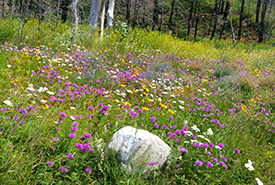
Wildflowers around Waterton Lakes National Park (Photo by Dave Kerr)
Story by Dave Kerr
"Board up your windows, seal off the lesser of your deck and pray that the air current changes."
Those were the last words of communication I heard from the firefighter in Waterton townsite as I and the residual of the worried cabin owners made final preparations before the mandatory evacuation and as the Kenow Mountain wildfire began to roar its manner through the park. Thankfully, the wind did modify, the firefighters performed miracles and the townsite was saved. Less and then the park itself.
Today, Parks Canada continues to reopen many of the hiking trails that had been closed following the wildfire in the fall of 2017. The fire affected 19,303 hectares (47,699 acres) or almost xl per cent of the park, including approximately sixty per cent of the trails that hikers have enjoyed for generations. For many, the return to favourite trails and viewpoints that accept been dramatically contradistinct by the intense wildfire is approached with regret and sadness. The loss of familiar trail experiences, sights, sounds and smells reminds us that life is constantly changing, frequently slowly, sometimes dramatically. Nonetheless such change is a natural and dynamic process and the regeneration of the trails in Waterton offers a special opportunity to see showtime-hand how a mountain landscape responds to such an event.
The jump of 2022 saw the first regrowth of many plants that are adapted to fire and take reward of bare soil and reduced tree canopy. Bright imperial fireweed is typically the most noticeable and extensive constitute to establish and provides a stunning dissimilarity to the blackened tree trunks and otherwise bare slopes.

Purple fireweed around Waterton Lakes National Park (Photo by Dave Kerr)
The typical view that returning hikers saw following Parks Canada's partial re-opening of the trail network in 2019/xx was tree trunks were black, grayness or white, resulting in a ghost-like landscape when viewed from afar. The near view of the trail margins and immediate environment, still, provided a story of stunning resilience and bright colours, with regal bergamot, brown-eyed Susan, xanthous arnica and blue and imperial asters being some of the most mutual to be seen.
Long known for its wildflowers, Waterton supports many plants and animals that are found but in this southwestern montane environs.
Already, many of the plants familiar to hikers in the park tin again be seen on the re-opened trails. A common question on looking at the slopes from afar is "what's growing there now?" or "when will the trees come back?"
The reply lies in woods succession, a concept where growth begins on burned over or cleared basis. It is then followed by recognizable stages of increasing vegetation diversity and growth of ground comprehend, understory, and finally shrub and tree growth forms. While early on stages may initially keep rapidly, subsequent stages of shrub and tree growth may take considerably longer. Full tree growth may take from twenty to 100 years, depending on the tree species and site or microclimate conditions.
Forth many of the trails in Waterton, former mixed forests of lodgepole pine, subalpine fir, mount maple and white spruce are beginning the early stages of succession with a variety of understory growth of alder, willow, low-bush cranberry, meadowsweet, thimble berry and cow parsnip. Today, this regrowth gives many of the slopes a patchwork green blanket below the otherwise standing or fallen dead tree trunks.
Elsewhere, the burn down intensity has left little of the surface organic matter, seed or shoot material that would allow more rapid regrowth. For these slopes and portions of some trails, a much longer time menses will be needed for the breakdown of woody material, organic thing build-upwards and plants to colonize again. This process may well accept longer in response to climatic change, where growing seasons are altered in both farthermost temperatures and moisture conditions.
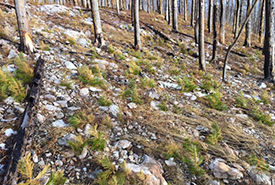
Seedlings growing after the Kenow wildfire (Photograph by Dave Kerr)
Tree growth has, yet, already begun for those species specifically adapted to fire. Lodgepole pino, whose cones typically require the heat from fire to open up, can be seen on open slopes, often with large numbers of one- or two-year old seedlings growing together. This re-growth tin pb to a dense, even-aged stand up of pines, providing hiding embrace for a multifariousness of wild fauna throughout the seasons.
Birds and animals too have started to render. Woodpeckers can be seen and heard hunting for wood-tedious insect and beetle larvae in the trees, forth with mountain bluebirds, northern flicker, chickadees and the ever-present squirrel and chipmunks eager to see the hikers return. While the trails may await very different from before the fire, there is even so much to be seen as the bicycle of forest growth begins afresh.
For decades, the Nature Conservancy of Canada (NCC) has worked with individual landowners to protect the surface area surrounding Waterton Lakes National Park, creating a natural buffer for the species that live in this area. To acquire more than nearly NCC properties you can access in this surface area, visit connect2nature.ca. For Waterton Lakes National Parks trail openings and weather condition, please refer to the Parks Canada website.
Source: https://www.natureconservancy.ca/en/where-we-work/alberta/stories/return-to-the-trails-hiking.html
0 Response to "Waterton Lakes When Will Areas Closed by Wildfire Open Again"
Enregistrer un commentaire